
You’ve booked the session. Now you’re wondering what actually happens when you walk through the door — whether the safety briefing is scary, how quickly you start throwing, whether you’ll embarrass yourself in front of your group, and what a 60-minute session actually looks like from first arrival to final throw.
This guide walks through every single stage of an Axeperience session in detail. Not the vague version. The exact version — what happens, in what order, how long each part takes, what you’re thinking, and what you’re feeling. By the time you arrive, nothing will surprise you.
| “I had no idea what to expect. By the end I wished it was longer. The whole thing just flows — there’s never a dull moment.” — Google reviewer, Axeperience London |
Before You Arrive: What to Know
A few things worth knowing before you get to the venue:
- Arrive a few minutes early, especially if it’s your first visit. Not 20 minutes early — 5 minutes. Sessions start on time because there are other groups following yours.
- Bring your booking confirmation, either printed or on your phone. The booking reference is all you need.
- Wear closed-toe shoes. Trainers, boots, flat pumps with a covered toe — anything that fully covers your feet. This is the one non-negotiable requirement and there are no exceptions.
- You don’t need to bring anything else. Equipment, axes, targets, scoring — all provided. Just bring yourself.
Stage 1: Arrival (0–5 minutes)
You arrive at Axeperience Tower Hill — Basement Floor, 48-51 Minories, EC3N 1JJ, a few minutes’ walk from Tower Hill tube station. The entrance is clear and well-signposted. The reception area feels more like the entrance to a cool bar than a sports venue.
You give your name, your booking is confirmed, and you’re directed to your lane. The atmosphere is immediately different from what most people expect. It’s social and lively, not clinical or intimidating. There are usually other groups already throwing in adjacent lanes, which gives you a preview of what you’re about to do — and almost always makes you more excited.
You can store bags and coats in the designated area. Nothing valuable needs to stay on your person during the session.
Stage 2: Meeting Your Instructor (5–8 minutes)
Your instructor introduces themselves at your lane. This is worth paying attention to because your instructor sets the tone for the entire session — and the instructors at Axeperience are consistently cited in reviews as one of the highlights of the experience.
In the first few minutes they’ll assess the group: who’s clearly excited and ready to go, who’s a little nervous, who’s already making competitive noises. They tailor their delivery to the group in front of them. A corporate group of twelve gets a different energy than a hen party of six.
You’ll notice the lane in front of you: the two wooden targets, the throwing line on the floor, the axes racked and ready. Everything looks purposeful and well-maintained. The axes are smaller than most people expect — not the dramatic double-headed movie axes, but compact, well-balanced throwing hatchets.
Stage 3: The Safety Briefing (8–15 minutes)
This is the most important part of the session and the part most people are slightly nervous about. The reality is that the briefing takes about seven minutes and is delivered in plain, direct language — not in the tone of a health and safety induction.
Your instructor covers:
- The throwing line: you throw from behind it, always. You don’t approach the target until it’s confirmed clear.
- The lane-clear protocol: nobody moves toward the target while any axe is still in flight. The instructor calls ‘clear’ and you all walk forward together to retrieve axes.
- How to hold the axe: the grip, where your hands go on the handle, and what happens to your wrists during the throw.
- Body position: where to stand, how to face the target, what to do with your feet.
- The release: the most important technical point — when to let go, and roughly where in the throwing arc the axe should leave your hands.
The briefing is clear and memorable because it’s focused. There are no digressions, no paperwork, no videos. Your instructor covers the essentials and then moves straight into teaching you to throw.
Stage 4: The Technique Demonstration (15–20 minutes)
Your instructor picks up an axe and demonstrates the throw. Most groups fall quiet at this moment. Watching a well-thrown axe spin cleanly through the air and thud into the bullseye is unexpectedly satisfying even before you’ve thrown one yourself.
They demonstrate both techniques you’ll use during the session:
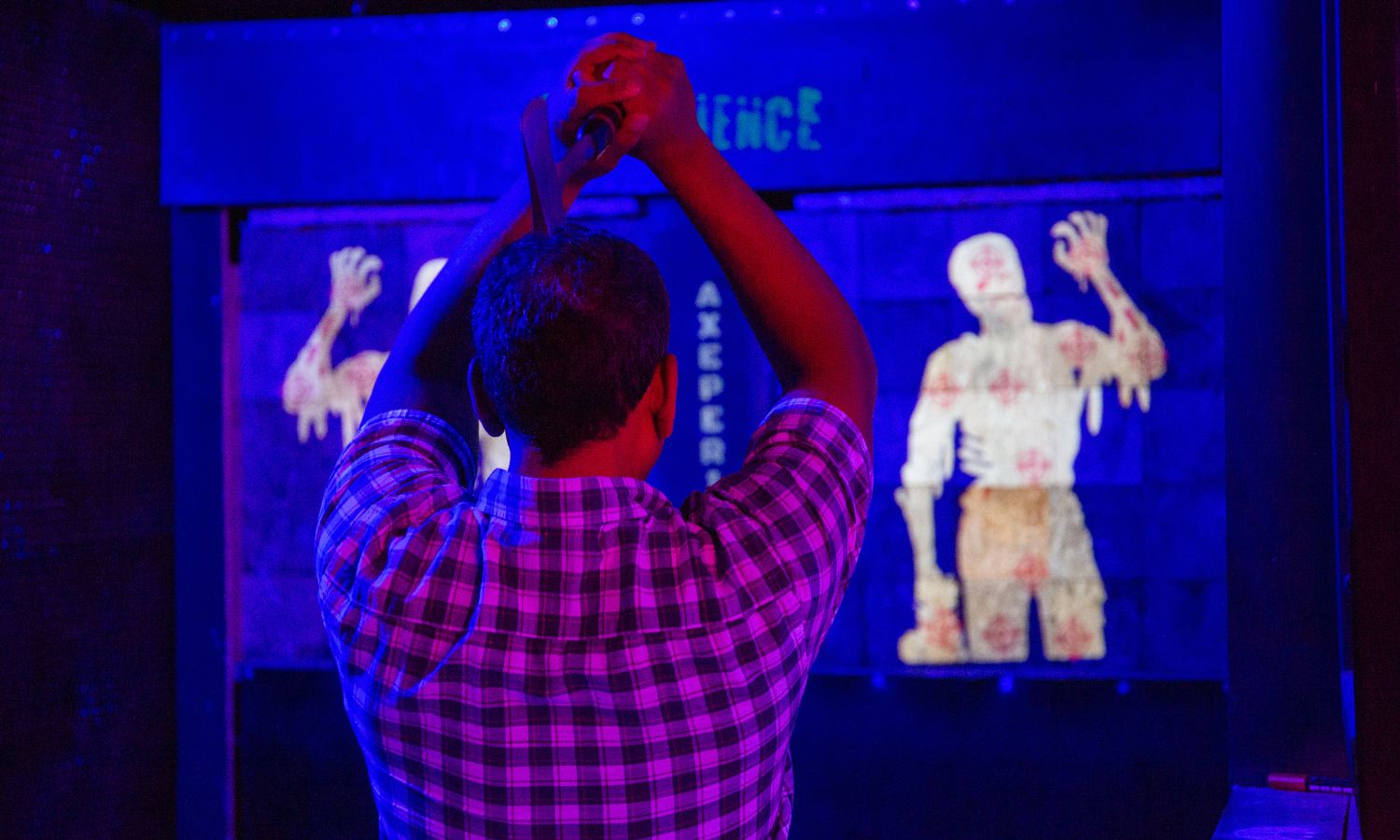
The two-handed throw: Both hands on the handle, arms raised above the head, step forward, and release. This is the standard beginner technique and the one most people start with. It gives the most control over the rotation.
The one-handed throw: Single hand on the handle, arm raised, step and release. Slightly more natural for some people, especially those with a background in any overhead sport. Instructors usually introduce this once the group has a feel for the two-handed technique.
After demonstrating, your instructor asks if anyone has questions. Most people at this point are too eager to start throwing to ask questions. That’s normal — the questions usually come after the first few throws.
Stage 5: Your First Throws (20–35 minutes)
This is the moment. You pick up an axe for the first time.
It’s heavier than expected if you’ve never held one — solid and purposeful. You stand behind the throwing line, both hands on the handle, arms raised. The instructor watches your grip. They may adjust something small — move a thumb, correct your foot position, remind you about your release point.
You throw.
The first throw almost never sticks. The axe hits the board and slides down, or bounces off, or lands with a dull thud and falls. This is fine. It happens to everyone. The instructor immediately tells you what went wrong — ‘you released too early’, ‘you’re gripping too tight’, ‘step further into it’. One specific thing to adjust. You try again.
By the third or fourth throw, something starts to change. The rotation looks right. The axe arrives at the target at a better angle. On throw five or six — for most people — it sticks. The sound is different: a clean, definitive THUNK rather than a bounce or a slide. You will know it immediately.
From this point, the session shifts. The nervousness dissolves. The competitive instinct that’s been dormant takes over.
Individual coaching during practice
While the group is throwing practice rounds, your instructor moves between players, watching each throw individually and providing specific feedback. They’re not giving general encouragement — they’re watching your specific technique and telling you the one or two things that will make the biggest difference to your consistency.
This is the part that surprises people most. The instructors at Axeperience are genuinely skilled at teaching a technical skill in a compressed timeframe. Most groups show visible improvement between throw 5 and throw 20 — not just in hitting the board, but in landing close to the bullseye consistently.
Stage 6: Games and Challenges (35–50 minutes)
Once the group has the basic technique, your instructor introduces the game formats. This is where the session really comes to life.
Standard scoring
The target has rings similar to archery scoring — bullseye in the centre, decreasing scores toward the outer edge. Your instructor introduces a scoring round: everyone gets a set number of throws and the scores are tallied. The informal leaderboard appears. Positions change. Someone who was struggling in the practice round hits three bullseyes in a row. Someone who was confident starts missing. It’s genuinely unpredictable.
Zones and challenges
Depending on how the group is performing and what the mood calls for, your instructor may introduce target zone challenges — hit a specific area of the board, hit the outer ring deliberately, clear a ‘split’ between two zones. These add a strategic layer to what was previously pure power and timing.
Head-to-head rounds
The format that generates the most energy: two people throw simultaneously at adjacent targets and whoever scores higher advances. The group narrows down through a bracket. People who’ve never been particularly competitive in their lives find themselves genuinely invested in the outcome.
Stage 7: The Final Competition (50–58 minutes)
The session builds toward a final round — the unofficial championship of the group. Your instructor announces it and the energy in the lane immediately shifts. The same people who were laughing off missed throws fifteen minutes ago are now standing slightly further back from the line, visualising their release point.
The final round format varies based on the group, but it always has a clear outcome: one person wins. And the winner is almost never the person anyone would have predicted at the start of the session. This is consistent across thousands of groups — axe throwing has a remarkable ability to surface unexpected champions.
The winner is announced. There is always noise about this. Bragging rights are formally established.
Stage 8: Final Throws and Close (58–60 minutes)
Your instructor gives the group a final few minutes of open throwing — no scores, no pressure, just the satisfaction of the technique you’ve developed over the last hour. Most people use this time to attempt something more ambitious: aiming for a specific ring, trying the one-handed technique if they haven’t yet, seeing if they can hit three bullseyes in a row.
Then it’s axes down, session over. The instructor calls it clearly and everyone lowers their axes. Sixty minutes that felt like twenty-five.
The debrief happens naturally in the minutes after the session ends — the stories of the unexpected champion, the person who improved most dramatically, the throw that almost hit the bullseye and then didn’t, the one that did. These are the conversations that continue at the bar.
What Happens if You’re Really Struggling?
Some people find the technique difficult to pick up quickly. This is not a problem. Instructors at Axeperience are accustomed to working with a wide range of ability levels within the same group, and they’ll give you additional individual attention without making it obvious to the rest of the group.
If an axe isn’t sticking for you, your instructor will simplify: stand at this exact spot, hold it like this, release when your arm is at this angle. Reduced to its components, the technique becomes much more manageable. Nobody leaves a session without having stuck at least a few axes.
One More Thing: It’s Louder Than You Expect
This isn’t a warning — it’s something people consistently mention in reviews as a positive surprise. The sound of an axe hitting a wooden target is immensely satisfying. When multiple lanes are running simultaneously, the combined sound is genuinely exciting. It makes the whole experience feel more visceral and real than any description prepares you for.
It’s one of the reasons axe throwing generates the reaction it does: it’s not just a skill activity, it’s a full-sensory experience that’s unlike almost anything else you can do for a group evening in London.
| Ready to find out what a bullseye sounds like? Book your session from £30pp at axeperience.co.uk/booking/ — London Tower Hill and Birmingham. |