
It’s the question everyone thinks before they book, and the one nobody quite wants to be the first to ask out loud. You’re about to throw a sharp axe at a target. Your group will be doing the same. Is this actually safe?
The honest answer is yes — with a big caveat attached. Axe throwing at a professionally run venue with certified instructors and purpose-designed lanes is a safe, controlled activity. Thousands of people do it every week across the UK without incident. Accidents at reputable venues are exceptionally rare, and when they do occur, they’re almost always minor.
But ‘safe’ doesn’t mean ‘zero rules’. Understanding exactly how venues keep axe throwing safe — and what your role in that is — will make your session more relaxed and more enjoyable. This guide covers everything honestly.
| “I genuinely thought I’d be nervous the whole time. Within five minutes of the safety briefing I realised I was worrying about nothing.” — Google reviewer, Axeperience London |
What Makes Axe Throwing Safe? The Full Picture
Professional axe throwing venues like Axeperience aren’t letting people randomly hurl weapons around. The safety of the activity is designed into every element: the venue layout, the equipment, the staffing model, and the session structure.
- Fully enclosed throwing lanes — axes travel in one direction only, in a contained space
- Certified instructors present for every single throw in every lane
- Purpose-built axes — balanced, maintained, and designed specifically for this sport
- Clear rules that cover every meaningful risk scenario
- Pre-session safety briefing before anyone touches an axe
- Strict 18+ policy with no exceptions
The Physical Environment
Enclosed Lanes
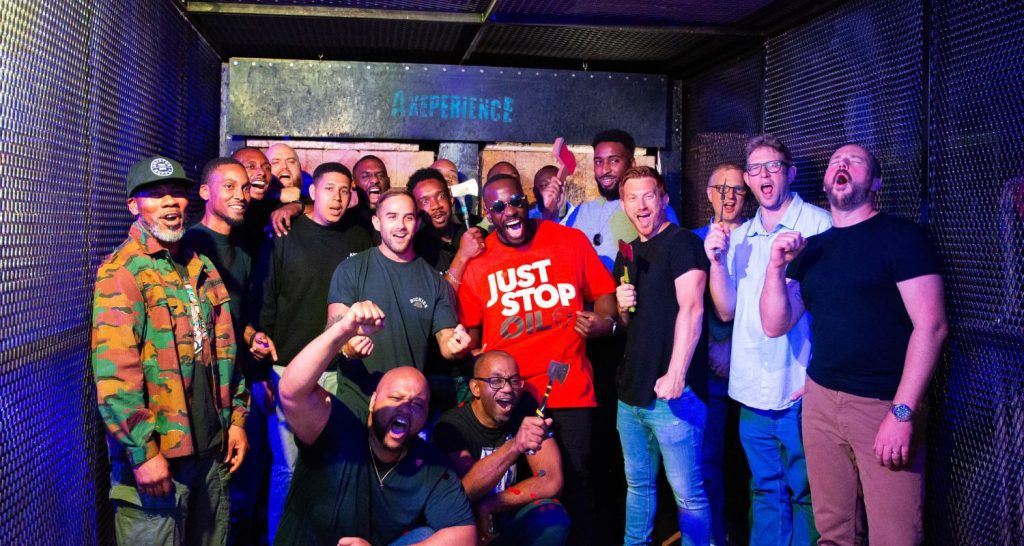
Every lane at Axeperience is fully enclosed — think of a wide, deep bowling lane with solid barriers on each side. When you throw, the axe travels in one direction: forward, toward the target. There’s no way for an axe to travel sideways into another lane. Nobody except your group and your instructor is ever in your lane during a session.
Throwing Distance
The distance from the throwing line to the target is precisely calibrated. At this distance, the axe completes the correct number of rotations before hitting the wood. This isn’t cosmetic — it’s the distance at which the technique works correctly, which is also the distance at which the activity is safest. You don’t choose where to stand; the system is designed for you.
Target Construction
The targets are purpose-built wooden boards designed to absorb the impact of an axe and hold it in place. A properly thrown axe that hits the board stays in the board. The wood is maintained and replaced regularly to ensure axes don’t bounce unpredictably.
The Equipment
The Axes
The axes used at Axeperience are not repurposed tools or improvised gear — they’re purpose-built throwing hatchets, specifically weighted and balanced for this activity. They’re inspected regularly and removed from use if they show any sign of damage or wear. The weight and balance of the axe is part of what makes the technique work consistently.
Protective Equipment
Closed-toe shoes are the only equipment requirement on your side. There are no helmets, no gloves, no protective gear required — because the activity is designed so that none of it is necessary. If the lane is clear before you throw and you’re throwing from the correct position, the axe goes to the target and nowhere else.
The Instructors
This is the most important safety element in the whole equation. Every session at Axeperience is supervised by a certified instructor from the moment you arrive to the moment you stop throwing. Here’s what that looks like in practice:
- Your instructor gives a complete safety briefing before anyone throws
- They demonstrate correct technique and watch each person’s first throws individually
- They are watching the lane at all times during the session — not on their phone, not distracted
- They enforce the lane-clear rule without exception: nobody approaches the target until they confirm it’s safe
- They correct unsafe technique immediately — a grip that could cause the axe to slip, a stance that could cause a stumble
The instructor isn’t just there for entertainment. They’re a trained safety professional doing a safety job. Listening to them in the first ten minutes of your session is the most important thing you can do to ensure a safe and enjoyable experience.
| “The instructor was incredible — totally calm and in control the whole time. Made everyone feel safe without making it feel like a lecture. Real skill.” — Tripadvisor review, Axeperience London |
The Safety Rules — What They Are and Why They Matter
These are the rules that apply at every Axeperience session. They’re not arbitrary — each one exists to address a specific risk.
Rule 1 — Closed-toe shoes are mandatory: Protects your feet in the event of a dropped axe. No exceptions. No closed-toe shoes means no session.
Rule 2 — Nobody approaches the target while axes are in flight: The single most important rule. You wait at the throwing line until the instructor confirms the lane is clear, then approach to collect axes together as a group.
Rule 3 — Only throw from behind the throwing line: The line exists for a reason. Throwing from closer creates an unpredictable rotation that may not result in a clean stick — and puts you closer to the ricochet zone.
Rule 4 — Axes are held and passed safely: When carrying an axe, hold it by the handle with the blade pointing down. You don’t swing it around. You don’t hand it blade-first.
Rule 5 — Instructor’s instruction is final: If the instructor tells you to stop, stop immediately. This isn’t something that gets debated.
Rule 6 — Alcohol during sessions: Axeperience operates a no-alcohol-during-session policy. Any post-session drinks are entirely separate from the throwing activity.
What About Ricochets?
This is the question that comes up most. What happens if the axe bounces back?
Ricochets are rare when the axe is thrown correctly from the correct distance. A well-thrown axe hits the wood at the right angle with enough rotational force to stick — not bounce. When the axe doesn’t stick (as happens frequently with beginners), it usually slides down the board or falls at the base of the target. It doesn’t fly backward toward the thrower.
The cases where a ricochet is possible are: throwing from too close (breaking Rule 3), throwing with incorrect technique that causes the axe to hit at a bad angle, or throwing at a damaged board (which is why boards are regularly replaced). Your instructor monitors all three.
The throwing line is positioned so that even in the event of an atypical ricochet, the physics of the situation mean the axe would fall well short of the throwers. This is deliberate venue design, not luck.
The Age Limit — Why 18+ Is Absolute
Axeperience is strictly 18+. This is non-negotiable and there are no exceptions, even with parental consent.
The age limit exists not because the activity is fundamentally too dangerous for anyone under 18, but because the insurance, regulatory framework, and safeguarding requirements for venues that permit under-18s to use sharp implements are substantially more complex. Rather than navigating those complexities in a way that could compromise the safety standards for everyone, the decision was made to operate as an adult-only venue.
This also means you can book with confidence knowing that every group in the venue has cleared the same age threshold.
How Does Axeperience’s Safety Record Stack Up?
With over 7,500 five-star Google reviews across London and Birmingham, and thousands of sessions completed, Axeperience has a safety record that speaks for itself. The reviews consistently praise the quality of instructor-led safety briefings as a highlight — not a formality. The venue’s ranking as Europe’s #1 rated axe throwing venue is a direct reflection of how seriously the team takes the experience, which includes the safety dimension.
Nobody arrives at Axeperience and leaves feeling that the safety standards were anything other than completely professional.
Frequently Asked Questions About Axe Throwing Safety
Is axe throwing safe for complete beginners? Yes. Sessions are designed specifically for people with no experience. The instructor coaches your technique from scratch.
What happens if someone in my group is nervous? The instructor will work with nervous participants at their own pace. There’s no pressure to throw before you’re ready.
Can I get hurt watching if I’m not throwing? No. Spectators stand behind the throwing line, which is behind the throwers. The throw moves away from spectators.
Are the axes sharp? They’re sharp enough to stick in wood when thrown correctly. They’re not sharp enough to cause a severe injury from incidental contact — but they should always be handled with respect.
What’s the most common minor injury? Blisters from gripping the handle too tightly, and occasional bruising from axes that fall from the target. Serious injuries are extremely rare.
Is axeperience insured? Yes. All commercial axe throwing venues are required to carry appropriate public liability insurance.
The Verdict
Axe throwing is safe. Not in the sense that sharp objects are involved and nothing could theoretically go wrong — they are, and something theoretically could. But in the real-world sense that matters: thousands of groups complete sessions every week, instructors are trained professionals, the physical environment is designed to contain risk, and the rules that exist cover every meaningful scenario.
Your job is simple. Listen to the safety briefing. Follow the rules. Wear closed-toe shoes. Everything else, including the safety of your session, is handled.
| Book your session from £30pp at axeperience.co.uk/booking/ — London Tower Hill and Birmingham. Expert instructors every session. |